
- Share
- Share on Facebook
- Share on LinkedIn
Background
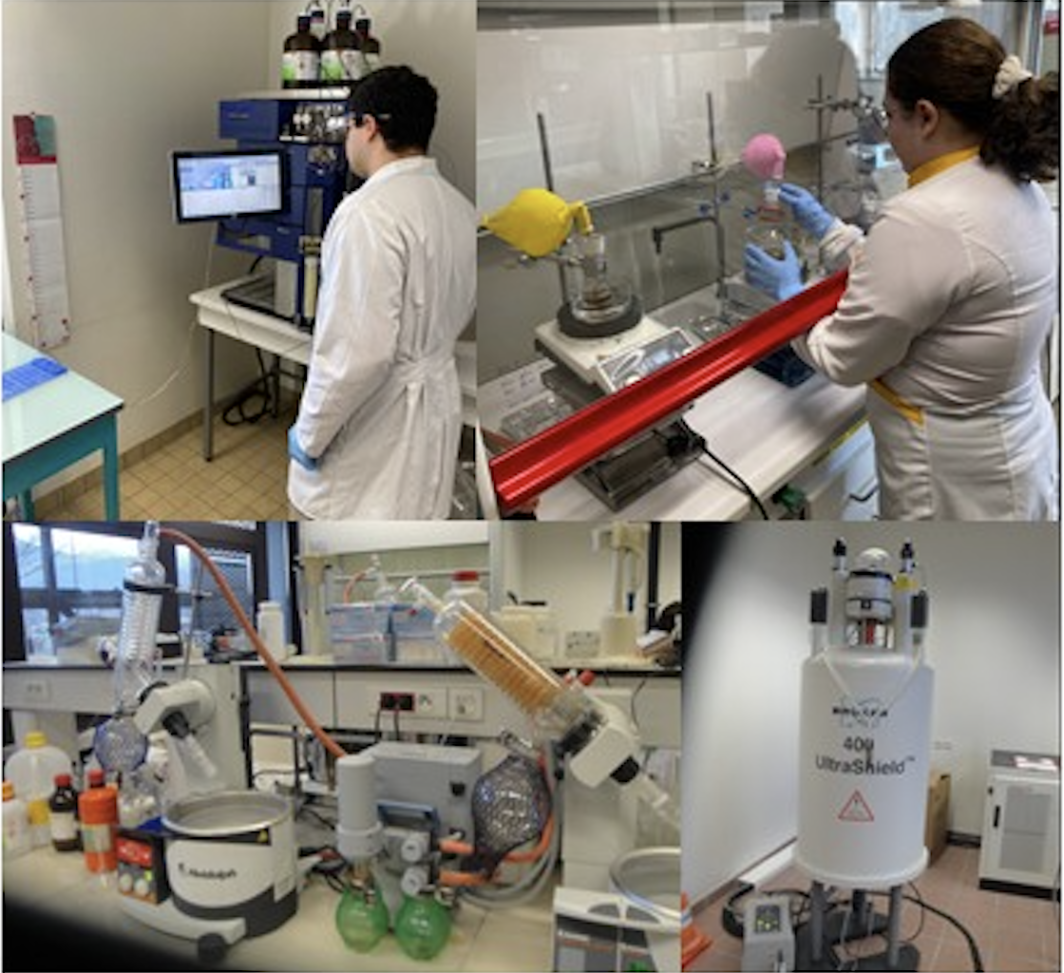
The major scientific advances in the development of treatments for chronic diseases enable better patient care. Unfortunately, these treatments face challenges due to the resistance of the diseases they are designed to combat. This is why innovation is essential—using groundbreaking new approaches to develop targeted and more effective treatments. It is in this context that our medicinal chemistry activity operates. We focus on developing innovative drug candidates within a multidisciplinary framework, in collaboration with national and international collaborators.
Objectives
The LRB’s medicinal chemistry activity aims to design and develop new generations of drug candidates in the fields of oncology and infectious diseases.
Current Projects:
-
Oncology - ARCANE Project
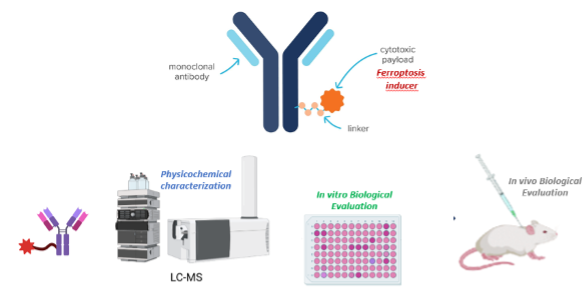
Ferroptosis, a form of non-apoptotic and iron-dependent cell death, has recently emerged as a promising strategy for the development of novel anticancer therapies. In this context, ferroptosis inducers are attracting growing interest. Meanwhile, antibody–drug conjugates (ADCs), which combine cytotoxic small molecules with antibodies for their targeted delivery, are gaining ground as therapeutic strategies to selectively eliminating cancer cells.
In 2022, our team was the first to report the design and synthesis of an ADC that combines a ferroptosis inducer with a monoclonal antibody: trastuzumab. Initial biological evaluations have yielded particularly encouraging results.
The ADC project submitted to the EUR is fully aligned with this strategy. It aims to develop a new generation of conjugates that combine novel ferroptosis-inducing molecules with monoclonal antibodies. Led by a chemist specializing in the medicinal chemistry of anticancer agents and a biologist with expertise in cancer biology, this project holds strong therapeutic potential in oncology. It will also help establish a new and timely research focus around ferroptosis.
In the longer term, the outcomes of the ADC project may open promising avenues in a related emerging field: “cuproptosis”, a recently described form of copper-dependent cell death.
-
Infectious Disease - Antifungal Project
Fungal infections affect over a billion people each year, including three million cases of invasive disease, roughly half of which are associated with high mortality rates. Species of the Candida genus are the primary culprits. Current treatments rely heavily on azoles, but their effectiveness is increasingly compromised by the emergence of antifungal resistance, particularly due to the expression of Cdr1, a membrane efflux pump that expels drugs from fungal cells, leading to treatments becoming ineffective.
Targeting this pump represents an innovative and still underexplored strategy for combination antifungal therapy. Our project aims to develop Cdr1 inhibitors in order to restore the efficacy of azoles against resistant strains.
We have resolved the cryo-EM structures of Cdr1 in multiple functional states, laying the groundwork for the design of potentially active molecules. These compounds wilare then synthesized, characterized, and tested on both azole-sensitive and azole-resistant Candida strains.
Our goal is to identify one or two drug candidates effective against resistant fungal infections, with potential for future industrial development. The project builds on a multidisciplinary approach, combining medicinal chemistry, structural biology, and microbiology.
Contact
Principal Investigator
Ahcene Boumendjel
ahcene.boumendjel univ-grenoble-alpes.fr (ahcene[dot]boumendjel[at]univ-grenoble-alpes[dot]fr)
ORCID : 0000-0002-1830-6409
- Share
- Share on Facebook
- Share on LinkedIn